
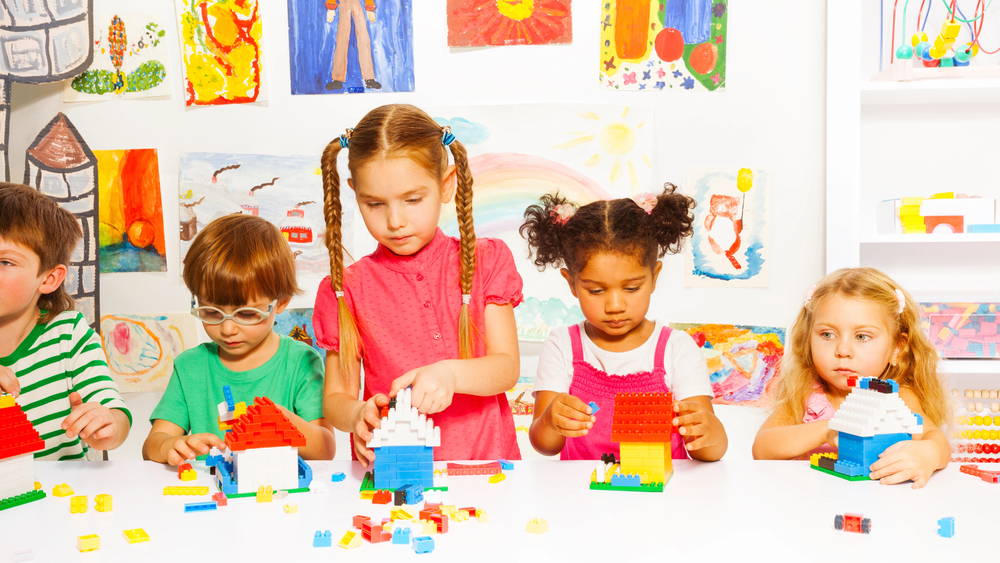
Child’s Eye Exams group of young children playing with colorful blocks on white table

Preschool Registration and the ABCs of Your Child’s Eye Exams

Preschool registration marks a significant milestone in a child’s educational journey, opening the doors to a world of learning and discovery. Children are introduced to a structured learning environment, but they also build social and cognitive skills. In this environment, young minds take their first steps toward independence, creativity, and cooperation. Preschool offers opportunities for growth, as children prepare to immerse themselves in a nurturing environment designed to foster curiosity and a love for learning.

Did you know that 5-10% of preschoolers and 25% of school-aged children may face vision problems? Every experience a preschooler encounters is a chance for growth, and their vision plays a crucial role in guiding these learning adventures.

Between the ages of 2 and 5, your child is refining the visual skills acquired during infancy while developing new ones. As they embark on their pre-school journey, their vision becomes a key player in mastering tasks that pave the way for future academic success. Visually guided eye-hand-body coordination, fine motor skills, and visual perceptual abilities are honed, setting the stage for learning to read and write.

It’s important to understand the difference between a vision screening and a comprehensive eye examination. While vision screenings are helpful indicators, they can’t diagnose eye or vision problems conclusively. They may overlook up to 60% of children with potential issues, leaving a false sense of security. Hence, the importance of a comprehensive eye exam, especially before entering the first grade.

The American Optometric Association (AOA) emphasizes that one in four school-aged kids may have undetected vision problems, impacting crucial visual perceptual skills like recognition, comprehension, and retention.

To ensure your child’s vision is in top shape, follow these tips for their eye exams:

  • Schedule appointments during times when your child is alert and content, considering napping and eating routines.
  • Provide a detailed case history, including birth information, weight, medical history, and allergies.
  • Take note of any delays in motor development, poor eye tracking, or frequent eye rubbing or blinking.

At Bissell Eye Care our approach involves making the eye exam enjoyable for children. Our doctors utilize puppets and special lights to track and measure vision acuity. By assessing how the eyes track and turn, checking for refractive errors, and ensuring overall eye health, we make the process as smooth for a 2-year-old as for an adult.

Even if your child hasn’t mastered letters yet, we use shapes and colors for a stress-free experience. Remember, regardless of age, regular eye exams are important. If you have any concerns about your child’s vision or eye health, give our offices a call at 724-443-6767 or 724-226-0444. It’s all about setting the stage for a bright, clear future!


About Bissell Eye Care: John D. Bissell, OD owns and operates Bissell Eye Care servicing Northern Pittsburgh and Alle-Kiski Valley regions. With two locations to treat patients, we offer evening and Saturday appointments. Bissell Eye Care provides comprehensive eye examinations for the entire family beginning as early as 6 months, ocular disease detection and treatment, eyeglasses, sunglasses, activewear, contact lenses, and low vision examinations for those with significant vision loss. We accept most types of vision and health insurance plans. For more information, visit bisselleyecare.com or call our Bakerstown Office at 724-443-6767 or Natrona Heights office at 724-226-0444.

EYE EXAMS FOR KIDS

Attentive boy is looking in special apparatus, checking his sight. Portrait

As parents, it is easy to know when your child is sick or needs to be taken to the doctor. It is often more difficult for your child to know and tell you when they aren’t seeing as clearly as they should be. This is especially true with infants and toddlers.

Unlike adults that have had regular exams, children who have never had an exam do not have a baseline to measure their vision from. The world is new and exciting to them and they may not notice that what they are seeing is not as clear as they should be. As a parent, you can help to ensure they are experiencing life to its fullest by scheduling routine eye exams.

According to the American Optometric Association, infants should have their first eye exam at 6 months of age. Children should then receive their next eye exam at the age of 3 and then again at age 5-6, before they enter kindergarten.

As your children age, it is recommended that they receive a comprehensive eye exam every two years if no vision correction is required and every year if vision correction is required. While pre-schools and elementary schools do provide free eye screenings, they are not nearly as involved as a screening by your optometrist.

School exams check the basics, using the Seeing Eye Chart but do not look into the eye to see if there are any other issues that need to be corrected before permanent damage occurs. Often these screenings are inaccurate and can miss important eye issues because they are always not done by eye doctors but by school nurses or medical assistants not trained to pick up advanced eye issues. Reading a chart or looking into a machine is not a proper assessment of the visual function of the eye. An eye doctor can see if a nonverbal or young child needs glasses by dilating them and using a special scope that shines light into their eyes to read their glasses prescription.

As children grow they use their vision to develop skills such as:

  • Eye teaming (binocularity) skills.
  • Focusing skills.
  • Peripheral awareness.
  • Eye movement skills.
  • Eye/hand coordination.

It is important to give your child the proper start as you get ready to send them on their first day of school. If they have trouble seeing they will struggle to learn. At a young age we learn from what we see, from how we see other people interact and what the teacher writes on the board. If your child does not have the ability to see clearly, they are already starting out a few steps behind.

As parents, we would do anything to be able to help our children to be the best they can be. Vision is often one area where children may not know that something isn’t right. If they have poor vision they most times won’t feel pain or discomfort, they will simply just struggle to see in clarity. For this reason, they may not tell you that they are having trouble as blurry vision may have become “normal” to them.

As you complete your back to school to do list, be sure to schedule your child’s eye exam.

About the author: John D. Bissell, owner of Bissell Eye Care and Tri-State Low Vision Services, offers comprehensive eye examinations for the entire family, ocular disease detection and treatment, eye glasses, sun glasses, active wear, contact lenses, and low vision examinations for those with significant vision loss. He has undergone specialized training for treatment of low vision by the International Academy of Low Vision Specialists utilizing customized telescopic eyeglasses, prisms and telescopic implants for patients who qualify. The practice accepts most types of vision and health insurance plans.