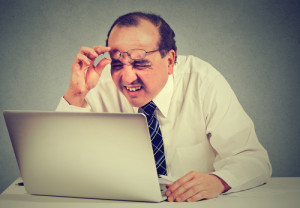
As you age not only does your wealth of knowledge grow, but also the chances increase that you may develop Age-Related Macular Degeneration or AMD. It is important to maintain not only routine doctor appointments, but eye doctor and dental checkups as we age. Doing so may help you to have a better quality of life as you enter the golden years.
With February being national AMD awareness month we want to educate you on the signs, symptoms and treatments of AMD. Knowing not only what to look for, but also how you can treat AMD will help ease the apprehension of maintaining your routine eye exams.
AMD is the leading cause of vision loss of people above the age of 50. AMD causes damage to the macula, a spot near the center of the retina. This disease blurs the sharp, central vision you need for “straight-ahead” activities such as reading, sewing, and driving. AMD affects the macula, the part of the eye that allows you to see fine detail. The rate at which damage can be done can vary. In some people it is a slow process over years. While with others it is more quickly and can also involve both eyes. While Age-related Macular Degeneration does not result in complete vision loss it can interfere with activities of daily living.
Who is more susceptible to developing AMD? Can your lifestyle make a difference as to your chances of developing AMD? As we discussed, people over the age of 50 are most likely to develop this disease.
Additional factors that may increase your risk are:
Smoking. Research shows that smoking doubles the risk of developing AMD.
Family history. If your family history includes AMD you are at a higher risk.
Ethnicity. AMD is more common in Caucasians that other races.
You have the power to take control of your health. These are some things you can do to help prevent AMD:
Exercise Regularly
Eat a healthy diet rich in leafy veggies and fish
Avoid smoking
Maintain proper vitals such as blood pressure and cholesterol.
AMD is best detected by maintaining routine eye exams. Often people question why dilation is part of a regular exam. This allows us to look into the back of your eyes for any changes that may be occurring.
While there is no cure for this disease, things such changing your diet and adding proper exercise can help to slow down the loss of vision. You have the power to choose. Take control and choose a healthier lifestyle. Your eyes will thank you for it.
About the author: John D. Bissell, owner of Bissell Eye Care and Tri-State Low Vision Services, offers comprehensive eye examinations for the entire family, ocular disease detection and treatment, eye glasses, sun glasses, active wear, contact lenses, and low vision examinations for those with significant vision loss. He has undergone specialized training for treatment of low vision by the International Academy of Low Vision Specialists utilizing customized telescopic eyeglasses, prisms and telescopic implants for patients who qualify. The practice accepts most types of vision and health insurance plans.
When you first hold your newborn and have counted 10 fingers and 10 toes, there is a sigh of relief that you delivered a healthy baby who will progress in development and growth. Dr. Nicole Long-Fratangelo, one of our optometrists at Bissell Eye Care’s Natrona Heights location, recently had her second child and shares her story with new parents.
In her own words…..
Everything was perfect. Alessio was born a healthy, beautiful baby boy. He was gaining weight and thriving. It was an exciting time for our family, we had just bought a new house and were in the process of moving. Alessio was three months old and while I was packing up my optometry equipment I decided to take a quick look at his eyes. My older, two year old son, Enzio, already had a full exam when he was six months old. However since I had my scope out I took a quick peek at both boys’ eyes and noticed that Alessio’s eyes had an abnormal reflex. A red reflex appears as the light bounces off the retina, and an eye doctor can use a special scope to read the prescription. I wasn’t too worried since a baby’s eyes can change a lot in the first few months after birth. I decided I would take him to the office for a full exam in a few weeks once things settled down a bit.
In the time between our move and his full exam I started to notice that Alessio wasn’t developing his fine motor skills as quickly as our first child. When I voiced my concerns, I was told, “All kids develop differently.” But I still worried. Alessio did not seem to grab for things and was often looking down at his legs and feet. He was not sitting straight or lifting his head up to look around like our first son, and something just seemed off.
At Alessio’s 4 month visit with his pediatrician, I shared my concern. Alessio’s eyes were straight and he showed no obvious signs of a vision disorder that the pediatrician could see. Many eye diseases, including high farsightedness, are often difficult to detect without a thorough eye exam. I told my pediatrician that I would be giving him an exam that included dilation.
You might wonder why dilate, particularly an infant? This allowed me to look into the back of his eyes and it was at that time I realized Alessio had an extremely high farsighted prescription. I was so upset, I examined him three times that day. Additionally, I took him to a pediatric ophthalmologist to confirm my findings – which they did. I have seen and confidently diagnosed children with this same issue but I could not believe that my perfect baby had spent the first four months of his life with very poor vision. Sometimes, it is good to just be a mom instead of your child’s doctor and mom. Even though I knew the answer, I needed to hear that I was doing the right thing.
Click on the image to watch me try on my new glasses!
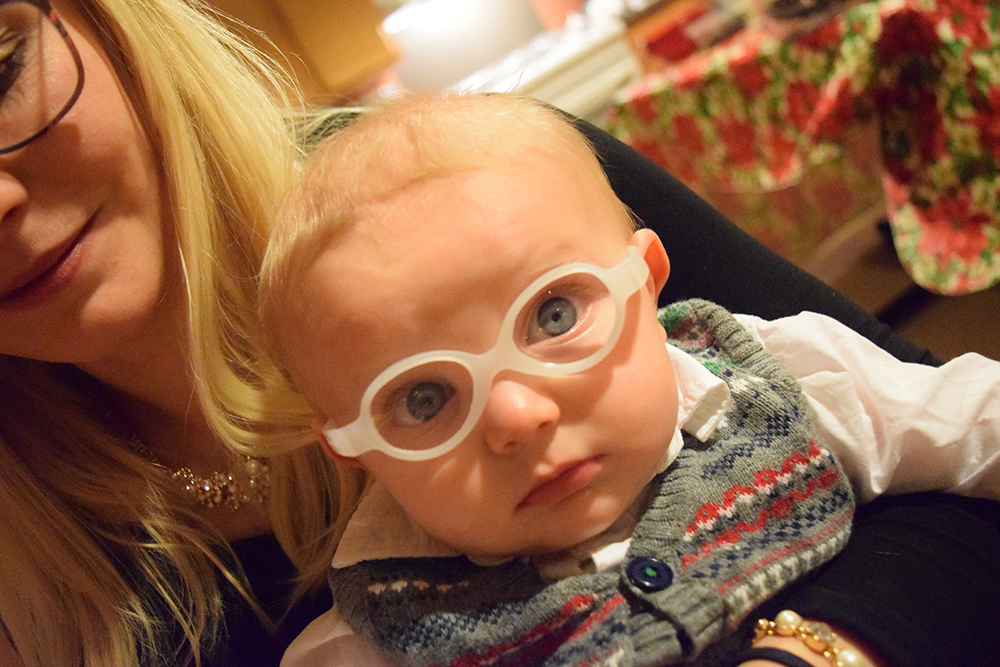
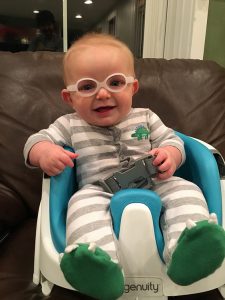
Alessio was fit with special glasses for babies and young children. Miraflex frames are soft glasses that flex and will not break. Bill at MB Optical did an amazing job getting his glasses made quickly and despite the high prescription, the lenses look amazing. I shared a video on our social media page of the first time Alessio wore his glasses. As his mom, I cannot begin to tell you what it felt like for him to see me and my husband clearly for the first time in his life. I was concerned that he would not leave the glasses on, but he loves his new glasses and exploring his new clear world.
Vision is essential in the proper development of a child. Because I was concerned that he may be behind developmentally, I contacted a therapist from the Infants and Toddler Alliance to evaluate Alessio’s development. Prior to getting his glasses, he was behind in language (babbling and imitation of facial movements that make sounds) and fine motor skills development. In the 3 weeks since he first got his glasses, he had a huge development boom and caught up with his fine motor skills. It is amazing every day to see him making huge strides in his development as he is discovering the things in the world that he was unable to see before. The therapist felt certain that his language development will come along as well.
Why am I sharing my story? Too often these vision issues are overlooked and not discovered until the child is in school. As a result, they are stuck playing catch up to their peers. At our practice, we educate all parents of new babies to have their child’s vision checked by an eye care professional before the age of one. Typically 6 months is a good rule of thumb. However if you suspect a problem, you can have your child examined earlier than 6 months.
Bissell Eye Care participates in InfantSEE®, a public health program, managed by Optometry Cares®. This program ensures that eye and vision care become an essential part of infant wellness care to improve a child’s quality of life. Under this program, participating optometrists provide a comprehensive infant eye assessment between 6 and 12 months of age as a no-cost public service. We check for excessive or unequal amounts of nearsightedness, farsightedness, or astigmatism, eye movement ability and eye health problems.
What’s in store for Alessio? He will always be in glasses, but through early detection, he now has the chance see clearly and develop normally. Alessio is fortunate because I am an optometrist, a mommy, and I followed both my professional training and instincts that something was not right.
My message to all parents, make an infant eye exam a part of your well baby check up!
About the author: John D. Bissell, owner of Bissell Eye Care and Tri-State Low Vision Services, offers comprehensive eye examinations for the entire family, ocular disease detection and treatment, eye glasses, sun glasses, active wear, contact lenses, and low vision examinations for those with significant vision loss. He has undergone specialized training for treatment of low vision by the International Academy of Low Vision Specialists utilizing customized telescopic eyeglasses, prisms and telescopic implants for patients who qualify. The practice accepts most types of vision and health insurance plans.
Infographic poster with detailed effects of untreated glaucoma disease showing the passing through a good and healthy eye to a progressive vision loss.
A new year is a time for a new beginnings, resolutions and making a fresh start. The top resolutions on the list typically are to lose weight and take better care of your health. As we turn the page on another calendar year and move into 2017, make sure taking care of your eyes is on the list.
January is National Glaucoma awareness month. Learn the effects of this disease, how early detection can prevent permanent vision loss and what treatment options are available should you be diagnosed with Glaucoma.
Risk factors and family history play a role in your chances of developing the disease. That’s why when you have an eye exam at Bissell Eye Care, we review your medical history to see if you might fall into any of these categories.
You are at a higher risk of developing glaucoma if you are over the age of 60, an African American over the age of 40 or if your family has a history of glaucoma. Other factors such as, high eye pressure, abnormal optic nerve anatomy and thinness of the cornea can contribute to increasing your risk factor. It is important to maintain routine eye exams in order to help detect glaucoma early.
During the early stages of glaucoma there are often no symptoms, no pain and no vision loss. Without treatment, as glaucoma develops it will cause a slow loss of the peripheral vision that may go unnoticed.
As time progresses, peripheral vision continues to deteriorate and it will begin to appear as though you have tunnel vision. If left untreated, glaucoma can eventually lead to total vision loss.
Early detection is key in helping to prevent permanent damage before it begins. During your routine eye exam you doctor will perform several checks that help to detect glaucoma. Some of the tests may include:
Visual Acuity Test: utilizes an eye chart to measure how well you see at different distances.
Visual Field Test: is used to measure your peripheral vision. It can show signs of early vision loss which could be one of the symptoms of the onset of glaucoma.
Pachymetry: is a simple, painless test to measure the thickness of your cornea — the clear window at the front of the eye. A probe called a pachymeter is gently placed on the front of the eye (the cornea) to measure its thickness. Pachymetry can help your diagnosis, because corneal thickness has the potential to influence eye pressure readings.
Ophthalmoscopy: this dilated eye exam uses drops to dilate your pupils allowing the doctor to look through your eye and examine the shape and color of the optic nerve and retina for signs of damage.
While there is currently no cure from glaucoma, preventative measures can help to reduce the chances of developing it. Once vision is lost to this disease it is impossible to ever regain that vision.
Be informed, take control of your health and protect your vision.
About the author: John D. Bissell, owner of Bissell Eye Care and Tri-State Low Vision Services, offers comprehensive eye examinations for the entire family, ocular disease detection and treatment, eye glasses, sun glasses, active wear, contact lenses, and low vision examinations for those with significant vision loss. He has undergone specialized training for treatment of low vision by the International Academy of Low Vision Specialists utilizing customized telescopic eyeglasses, prisms and telescopic implants for patients who qualify. The practice accepts most types of vision and health insurance plans.
Concept words FSA on wooden blocks on beautiful background from dollar bills.
Flexible Spending Accounts (FSAs) can help you to spend less on your health care while experiencing the maximum tax benefit. However, you must use monies within the current calendar year to reap the rewards. By spending all of the money in your account before the year-end deadline you ensure you are getting the most bang for your buck.
FSAs are pre-tax monies that are placed in an account and are available for use only on approved medical expenses. They differ from a health savings account, HSA, in that the money contributed can only be used for that calendar year. In other words, the FSA accounts are use it or lose it. As the year quickly draws to a close the question becomes, have you used it?
While there are no exceptions that allow that money to be directly paid back to you, there are more options that you might expect as to how to spend the extra money. You can contribute up to $2,550 to your FSA in a year. If you have monitored the amount spent during the year, you have an idea what is left to spend down as December quickly approaches. There are two cases where you can get a little extra time to spend that money.
A rollover option. This allows you to move up to $500 to next year’s balance.
Grace period. Because most plans fall on the calendar year, this option allows you to use the moneys for up to 2 ½ months past the end of the year. Why is this? Because, during the first few months of the year your account has accrued little funds.
Most FSA accounts come with a debit card and usually have one or the other of these two options but CANNOT have both. However, if you are required to submit a claim, be sure to watch the claim windows in which you are required to submit a claim.
How to spend FSA accounts?
If you have quite a bit left in your account, don’t despair. The list of things that you can spend the money on however is pretty large, leaving many surprised what they can purchase using their FSA account. To get a full listing of what you’re allowed to spend money on visit an online FSA store. These stores only sell items that qualify approved purchases using your FSA account.
Some out-of-the ordinary expenses you can pay for using your FSA account also include:
Chiropractor visits
Artificial teeth or limbs
Qualified service animals, such as a guide dog, including food and grooming costs
Travel that was required for medical treatment.
You may also use the FSA for expenses such as hearing, vision, and dental services even if you don’t have insurance for those services.
Keep track of your FSA account throughout the year and by spending in moderation throughout the year will also help to reduce the scramble to use money that you have left as the year comes to an end. Despite the hassle of having to make sure all the money is spent, FSA accounts are a good way to avoid paying taxes on money that is used for medical expenses.
About the author: John D. Bissell, owner of Bissell Eye Care and Tri-State Low Vision Services, offers comprehensive eye examinations for the entire family, ocular disease detection and treatment, eye glasses, sun glasses, active wear, contact lenses, and low vision examinations for those with significant vision loss. He has undergone specialized training for treatment of low vision by the International Academy of Low Vision Specialists utilizing customized telescopic eyeglasses, prisms and telescopic implants for patients who qualify. The practice accepts most types of vision and health insurance plans.
If you are one of the estimated 29.1 million people that have diabetes, then you have most likely had a discussion with you doctor about possible health related issues that comes with the disease. Diabetes also can have a negative effect on your eyesight. Obtaining regular screenings will allow you to monitor your health and react to any changes that may have occurred.
While it is important for everyone to maintain routine visits with their optometrist, people with diabetes need to be especially vigilant in scheduling their annual exams. Diseases such as Glaucoma, cataracts, and retinopathy are best treated when they are detected early. Talk to your eye doctor about any concerns or vision loss you may be experiencing for the best chances of early detection and treatment.
Glaucoma occurs when pressure builds inside the eye and is 40% more likely to occur in individuals who have diabetes. The pressure pinches blood vessels that carry blood to the retina and optic nerve. Vision is gradually lost as the retina and nerves are damaged from the increase in pressure. There are several treatments available for Glaucoma; however, some treatments may require surgery. Early detection of high pressure may be able to be managed by medication. Maintaining the proper eye pressure is key to preventing permanent damage to the eye.
As we age, many people run a higher risk of developing cataracts. Those with diabetes are 60% more likely to develop them. By detecting cataracts early you can help to slow down the progression. The typical corrective action for cataracts is to remove the lens of the eye. Patients then would typically receive a new transplanted lens. In people with diabetes, vision can get worse after the removal of the lens and glaucoma may start to develop so additional treatment may be necessary.
Retinopathy is a general term used for all disorders of the retina that are caused by diabetes. The good news that there have been giant strides in the past decade on treatment for retinopathy.
Have you noticed a pattern? Particularly those with diabetes must be extra vigilant with screenings and health checkups. The key to being able to keep your vision as clear as possible when you suffer from diabetes is early detection. Keep in mind that you often can lose more than 60% of your vision before you begins to see significant differences. Talk with your doctor if you have diabetes so you know what symptoms to look for and schedule your annual vision screening.
About the author: John D. Bissell, owner of Bissell Eye Care and Tri-State Low Vision Services, offers comprehensive eye examinations for the entire family, ocular disease detection and treatment, eye glasses, sun glasses, active wear, contact lenses, and low vision examinations for those with significant vision loss. He has undergone specialized training for treatment of low vision by the International Academy of Low Vision Specialists utilizing customized telescopic eyeglasses, prisms and telescopic implants for patients who qualify. The practice accepts most types of vision and health insurance plans.
As the leaves start to turn and the days get shorter, it becomes time to finalize your costume for Halloween. Are you ready for some Halloween parties? Costumes have gotten more complex as the years have gone by. There are a few things to keep in mind this year as you put the final touches on your costume.
Decorative or cosmetic contact lenses were introduced to the market a few years back and have gained popularity. While many people look at them as a prop or something that will simply change your eye color, remember that contact lenses are considered a medical device requiring a prescription. Places that sell decorative lenses without a prescription may give you few or no instructions on how to clean and care for your lenses. Failure to use the proper solution to keep contact lenses clean and moist can lead to infections. If you do choose to use them it is best to consult your eye doctor and even stop in for a quick visit and be sure that they fit properly.
Make up can be another unthought-of hazard to your eyes. Halloween is the one time of year where people can really become creative with makeup. Often when people put their Halloween face on, you are getting closer to your eyes than you normally would. While many people may not realize the danger to this, cosmetic makeup that is meant for the eye is tested and FDA approved. These types of makeup are less likely to injure the eye if it is accidently exposed. If you are planning using facial makeup be sure that it is hypoallergenic and safe to use near your eyes before you apply!
If using some type of mask, make sure you or your children are able to clearly see. Obstructive views can cause a trip hazard for young and old alike. Be sure that you costume allows you to adequately see, with large enough eye holes. Use approved makeup and contacts to create the best costume this year. Wishing you a safe and Happy Halloween!
About the author: John D. Bissell, owner of Bissell Eye Care and Tri-State Low Vision Services, offers comprehensive eye examinations for the entire family, ocular disease detection and treatment, eye glasses, sun glasses, active wear, contact lenses, and low vision examinations for those with significant vision loss. He has undergone specialized training for treatment of low vision by the International Academy of Low Vision Specialists utilizing customized telescopic eyeglasses, prisms and telescopic implants for patients who qualify. The practice accepts most types of vision and health insurance plans.
Are you enjoying the change in color on the landscape? Fall is certainly upon us as we see the leaves turning color and falling from the trees. It’s the time of year where fall cleanup will soon be in full swing. With the temperature dropping and the leaves changing color, they are falling to the ground covering your yard in what seems like a never ending task of clean up.
As you step outside with your rake or leaf blower, be sure to use the proper eye and ear protection to help keep you safe. Dead leaves tend to break apart as your rake them up or use your leave blower to corral them into a pile. Having proper eye safety can help prevent pieces of these leaves from being blown into your eyes. October is eye safety awareness month. Every year, 2.5 million eye injuries occur, and almost half of those injuries take place in the home.
While using a rake can seem harmless, when working outside moving large amounts of leaves, sticks, and other debris from your yard, you run the risk of having a foreign object enter your eye. I’m sure as a child you remember raking a giant pile of leaves and then jumping into them. Your kids will find the same joy that you did when you were younger. Perhaps you ended up with pieces of leaves in your eyes as you jumped into that massive pile. If your children are having fun with piles of leaves and get something in their eyes, be sure to flush with water to clean the eye.
If you’re using a leaf blower you may feel as though there is no danger, that all of the leaves are being blown away from you. Your eyes and ears are at danger of permanent damage when using a leaf blower if proper protection is not worn. Like any engine, leaf blowers, even electric ones, emit sound. This sound can be harmful to your ears and can cause hearing loss. A good sign of needing hearing protection is if you hear ringing, or feel uncomfortableness during or after the use of power tools. Next is to be sure to have eye protection. Even sunglasses are a good source of protection when using a leaf blower. As you blow the leaves, they get thrown up into the air where the wind can grab them and pull them back toward you. This can cause dirt and dust particles that have also been picked up to be blown back toward you. If they get into your eyes you can experience discomfort and may also scratch your cornea.
When using chemicals to clean stains before winter sets in, be sure to wear eye protection. Fully read labels on all chemical products. Never mix chemicals like bleach, detergents and cleansers together. Use cleaners and chemicals in well-ventilated areas, and wear safety goggles to avoid chemical splashes.
Remember this year as you step outdoors that even a simple pair of sunglasses can help to protect your vision. If you intend on using power tools to help clear the yard of those pesky leaves, add ear protection while using power tools along with the eye protection. Happy raking!
About the author: John D. Bissell, owner of Bissell Eye Care and Tri-State Low Vision Services, offers comprehensive eye examinations for the entire family, ocular disease detection and treatment, eye glasses, sun glasses, active wear, contact lenses, and low vision examinations for those with significant vision loss. He has undergone specialized training for treatment of low vision by the International Academy of Low Vision Specialists utilizing customized telescopic eyeglasses, prisms and telescopic implants for patients who qualify. The practice accepts most types of vision and health insurance plans.
Do you prefer to drive during the daytime? Do you have trouble seeing at night? If night driving is difficult, millions of Americans feel the same way. There are many different things that may cause trouble seeing at night. It can be as simple as needing a new eyeglass prescription, lacking vitamins, over exposure to the sun or the presence of cataracts. If you find that you are having trouble seeing at night, contact your eye doctor to rule out diseases that could cause long term loss of vision.
Below are some of the most common causes of vision loss in adults.
Cataracts. The eye’s lens is located behind the pupil. As you age cells grow and die inside of the lens. This causes debris to build up and leads to cataracts. Cataracts are not painful, however they will gradually cloud your lens. One of the first symptoms of cataracts is decreased visibility at night. Blurry vision is also common with cataracts or seeing halos around objects.
Lack of vitamin A. Vitamin A is found in many leafy vegetables and also in carrots. It helps to keep the retina healthy. While it is not common for many Americans to lack vitamin A, diseases such as Crohn’s disease, Celiac disease or Gastric bypass may make it difficult for the body to absorb needed vitamins. Not getting enough of needed vitamins can increase the chance of having decreased night visibility.
Retinitis pigmentosa. This is a rare genetic disorder that mostly affects younger people before they reach the age of 30. A decline in night vision is usually the first symptom, but can lead to total loss of vision.
Sunlight exposure. Having large amounts of sun light exposure, after a trip to the local ski resort or laying out on the beach, can burn your eyes. This is known as sun blindness and can last for a few days or longer depending on the amount of exposure and the frequency that you experience this exposure. Wearing sunglasses helps to prevent permanent damage to your eyes from the sun.
While many of these conditions can cause difficulty seeing at night, most of them are preventable or able to be treated. If night driving is difficult for you, talk with your eye doctor to rule out any treatable cause.
About the author: John D. Bissell, owner of Bissell Eye Care and Tri-State Low Vision Services, offers comprehensive eye examinations for the entire family, ocular disease detection and treatment, eye glasses, sun glasses, active wear, contact lenses, and low vision examinations for those with significant vision loss. He has undergone specialized training for treatment of low vision by the International Academy of Low Vision Specialists utilizing customized telescopic eyeglasses, prisms and telescopic implants for patients who qualify. The practice accepts most types of vision and health insurance plans.
It’s getting to be that time of year. Have you been bombarded with all of the health forms and documents that need filled out for your little one to either go back to school, or to start a new adventure in attending school for the first time? With all of the hustle and bustle in buying new clothes, school supplies, getting immunizations, and reviewing schedules, something as simple as your child’s eyesight can be overlooked.
Children often start their first few years of school without having an eye exam by an optometrist. While you can tell when your child is sick it is nearly impossible to determine when there is a problem that could be affecting their vision.
With August being Children’s Eye Health and Safety Month, we want to remind parents the importance of scheduling routine eye exams for children starting at the age of three. There is no better time to schedule your child’s checkup than before they start back to school and after school schedules and activities become hectic.
There are some signs to watch for that could indicate your child is having trouble seeing:
Wandering or crossed eyes.
Squinting or turning their head in an unusual manner while watching TV.
Disinterest in reading or focusing on things in the distance.
Or if there is a family history of childhood vision problems.
By having routine eye visits, eye doctors can monitor your child’s vision and eye health. This will help to detect any problems with your children’s eyes that could affect their vision long term. If their vision deteriorates, you may also see a decline in your child’s grades as struggling to see may set them at a disadvantage when it comes to watching and understanding what is being taught.
We want to stress the importance of eye safety. As school starts back, fall sports are in full swing. With high school sports become faster paced and highly competitive, more injuries are occurring. Eye injuries are often top of the list. By having your children wear the proper eye protection you can help reduce the chances of sustaining an eye injury, an injury that could leave them with a permanent vision loss.
Remember, as fall approaches it is important to have a regular eye exam done for children three and older and to have your children use the proper, approved eye protection as they participate in fall sports.
About the author: John D. Bissell, owner of Bissell Eye Care and Tri-State Low Vision Services, offers comprehensive eye examinations for the entire family, ocular disease detection and treatment, eye glasses, sun glasses, active wear, contact lenses, and low vision examinations for those with significant vision loss. He has undergone specialized training for treatment of low vision by the International Academy of Low Vision Specialists utilizing customized telescopic eyeglasses, prisms and telescopic implants for patients who qualify. The practice accepts most types of vision and health insurance plans.
If you are like most people when needing new glasses, you have tried on frame after frame, looking for the one that fits your face just right. It can be very overwhelming as you look at the wall of frames, trying to decide which frame you like best.
There are some ways that you can easily narrow the selection from hundreds of frames down to a select few, which will help you to find a pair that compliment your facial features.
The first part of choosing a set of eyeglass frames is to consider the shape and size of your face. Every face has a shape, round, oval, square, diamond or even heart-shaped.
Determining your facial shape will help you to narrow down the types of frames will best compliment your look.
Round: Square or rectangular frames often tend to be wider than a round face. This can help your face to appear slimmer and longer.
Oval: These often have a strong bridge. Avoid frames that are overlarge and cover up more than half of your face as it can throw off the symmetry of your face.
Square: You want to look for frames that sit high on the bridge of your nose. Oval or round glasses will add a thinner appearance. Avoid boxy eyeglass frames which will make your face appear squarer.
Diamond: You want to look for frames that sweep up and or are wider than then the cheekbones. You want to find frames that will accentuate your cheek bones.
Heart shaped: Ideal frames are low-set templets and bottom heavy frame lines. Round eyeglasses or square eyeglasses with curved edges will help draw attention away from a broad forehead.
When looking for eyeglass frames remember that in most cases opposites attract. You want to find a balance to your face. If you find frames that are the same shape as your head they can often throw the balance off.
The next thing to consider is what type of lifestyle you lead. Are you physically active, a gamer, or looking to make a fashion statement? You need to find frames that are flexible if you are active, enhance your gaming experience if you’re a gamer, and look stylish and sophisticated if you are looking to make a fashion statement.
At Bissell Eye Care, our trained staff are always available to help you select that perfect frame that best fits your face and lifestyle.
About the author: John D. Bissell, owner of Bissell Eye Care and Tri-State Low Vision Services, offers comprehensive eye examinations for the entire family, ocular disease detection and treatment, eye glasses, sun glasses, active wear, contact lenses, and low vision examinations for those with significant vision loss. He has undergone specialized training for treatment of low vision by the International Academy of Low Vision Specialists utilizing customized telescopic eyeglasses, prisms and telescopic implants for patients who qualify. The practice accepts most types of vision and health insurance plans.

 As you age not only does your wealth of knowledge grow, but also the chances increase that you may develop Age-Related Macular Degeneration or AMD. It is important to maintain not only routine doctor appointments, but eye doctor and dental checkups as we age. Doing so may help you to have a better quality of life as you enter the golden years.