Depositphotos_761340872_S

Eye Exams and Learning – A Winning Combo

When should you schedule your child’s first eye exam? We know 2020 was quite a different year for kids and school. For some children, spending multiple hours in virtual classrooms has taken a toll on their vision. Parents have turned to computer glasses that help reflect the UV lights from the blue screen. Children may be experiencing eye strain, headaches or you see them squinting. This could be a sign they need glasses.

Many preschools were on hold this past year, but there are signs of change as you may begin to notice registration advertisements for the 2021-2022 school year. According to the American Optometric Association (AOA), “infants should have their first comprehensive eye exam at 6 months of age.” Bissell Eye Care is a proud member of the InfantSEE® program and will do a free comprehensive examination on any child between six months and one year of age. Experts say 5 – 10 % of preschoolers and 25 % of school-aged children have vision problems.

As you prepare your child for their adventure into preschool, they will depend on their vision to learn tasks that will prepare them for school. Visually-guided eye-hand-body coordination, fine motor skills and visual perceptual abilities will be developed to enable your child to learn to read and write.

Amblyopia or lazy eye is not just a crossed eye (because everyone thinks that), but it is an eye that does not see as well as the other eye causing it to not develop proper vision for many reasons. Amblyopia is reversible when detected early. Treatment involves patching the better-seeing eye or blurring its vision using atropine drops. Amblyopia is the most common cause of vision problems in children.

Early identification of a child’s vision problem is crucial because, if left untreated, some childhood vision problems can cause permanent vision loss. Children then should have additional eye exams at age 3, and just before they enter the first grade – at about age 5 or 6.”

The AOA estimates one in four school-aged kids have undetected vision problems that critically impact their visual perceptual skills:

  • RECOGNITION – knowing the difference between letters like ‘b’ and ‘d’
  • COMPREHENSION – ‘picturing’ what’s happening in a story they’re reading
  • RETENTION – remembering and recalling details about what they’ve just read

Here are some tips for eye exams for young children.

  • Schedule the appointment during a time when your child is alert and happy taking into account napping and eating times.
  • A case history will be conducted to determine birth history, birth weight, medical issues, and any allergies.
  • Be sure to note any delayed motor development, failure to maintain eye contact, poor eye tracking, frequent eye rubbing or blinking.

Making a child comfortable with puppets and the use of our “Special Lights” allow us to have fun with children as we look for the following things:

  • How the eye tracks and turns
  • High Refractive Error – meaning significant far or nearsightedness
  • Overall Eye Health

For young children who can’t read letters yet, no worries, we use shapes and colors. No matter what age, regular eye exams are important. If you have concerns about your child’s vision, tracking ability or overall eye health, give our offices a call at 724-443-6767 or 724-226-0444.


About Bissell Eye Care: John D. Bissell, OD owns and operates Bissell Eye Care servicing Northern Pittsburgh and Alle-Kiski Valley regions. With two locations to treat patients, we offer evening and Saturday appointments. Bissell Eye Care provides comprehensive eye examinations for the entire family beginning as early as 6 months, ocular disease detection and treatment, eyeglasses, sunglasses, activewear, contact lenses, and low vision examinations for those with significant vision loss. We accept most types of vision and health insurance plans. For more information, visit bisselleyecare.com or call our Bakerstown Office at 724-443-6767 or Natrona Heights office at 724-226-0444.
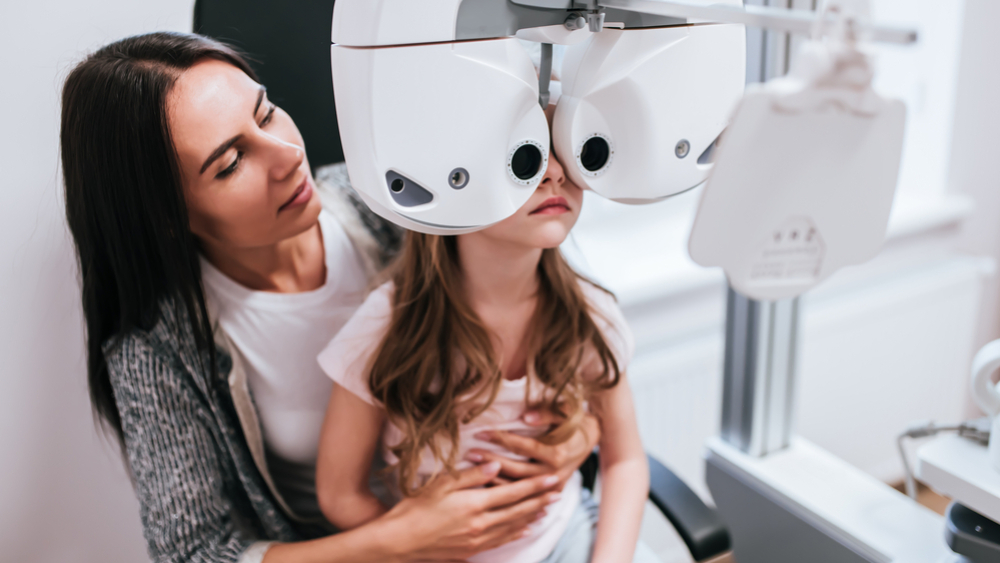
Mom with daughter in ophthalmology clinic

What to Expect at My Child’s First Eye Exam

American Optometric Association (AOA), states “infants should have their first comprehensive eye exam at 6 months of age.” Did you know that Bissell Eye Care provides eye examinations for free to children as young as 6 months up to one year old? As children enter preschool around 3 years of age they should be rechecked and then again right before kindergarten. Experts say 5 -10 % of preschoolers and 25 % of school-aged children have vision problems.

During a child’s eye exam, we will perform three assessments, including a vision test, pupil test, and eye movement test. You’ll be asked about your family’s medical history, your child’s medical history, developmental observations and any vision problems that you might be observing with your child.

We encourage you to stay with your child through the entire examination. Infants and small children sit on a parent’s lap during the exam. Older children are encouraged to sit in the exam chair by themselves.
Eye drops are used to dilate the pupils, which gives the optometrists a better view of the structures inside the eye, such as the retina, optic nerve, and blood vessels. The drops take about 30 to 45 minutes to become fully effective.

The Bissell Eye Care optometrists will carefully observe each eye as your child follows lights or toys. This gives a very good estimate of a child’s visual function. Children do not need to be able to talk or read to get an accurate eyeglass prescription. Children who talk but cannot read or count may be asked to identify pictures of common objects.

Once the dilation drops kick in, the doctor will use a retinoscope, a handheld polarized light, and lenses to read each of the eye’s red reflex. This allows the doctor to get an accurate eyeglasses prescription without feedback from the patient, allowing nonverbal or young children to get glasses.

These same eye drops also cause a temporary weakness of the eyes’ focusing muscles. This allows us to determine if your child has a focusing or refractive error that requires glasses. Refractive errors include:

  • Nearsightedness (myopia)
  • Farsightedness (hyperopia)
  • Distorted vision (astigmatism)

You may notice many preschools are starting to advertise registration for the 2020-2021 school year. Young children depend on their vision to learn tasks that will prepare them for school. During this time in their lives, they are developing the visually-guided eye-hand-body coordination, fine motor skills and visual perceptual abilities necessary to learn to read and write.

Early identification of a child’s vision problem is crucial because, if left untreated, some childhood vision problems can cause permanent vision loss. The AOA estimates one in four school-aged kids have undetected vision problems that critically impact their visual perceptual skills -better known – as the 3 R’s:

  • RECOGNITION — knowing the difference between letters like ‘b’ and ‘d’
  • COMPREHENSION — ‘picturing’ what’s happening in a story they’re reading
  • RETENTION – remembering and recalling details about what they’ve just read

Here are some tips for eye exams for young children:

Schedule the appointment during a time when your child is alert and happy taking into account napping and eating times.
A case history will be conducted to determine birth history, birth weight, medical issues, and any allergies
Be sure to note any delayed motor development, failure to maintain eye contact, poor eye tracking, frequent eye rubbing or blinking.

Prepare your child for success as they enter preschool and beyond. To schedule your child’s eye exam, give our offices a call at 724-443-6767 or 724-226-0444.

About Bissell Eye Care: John D. Bissell, OD owns and operates Bissell Eye Care servicing Northern Pittsburgh and Alle-Kiski Valley regions. With two locations to treat patients, we offer evening and Saturday appointments. Bissell Eye Care provides comprehensive eye examinations for the entire family beginning as early as 6 months, ocular disease detection and treatment, eyeglasses, sunglasses, activewear, contact lenses, and low vision examinations for those with significant vision loss. We accept most types of vision and health insurance plans. For more information, visit bisselleyecare.com or call our Bakerstown Office at 724-443-6767 or Natrona Heights office at 724-226-0444.

Dr. Johnson retires and sells practice to long time friend and Dr. John Bissell

Childhood Dreams Become Reality

Who says childhood dreams don’t come true?  For Dr. Bissell, he knew at an early age he wanted to become an optometrist.  Dr. Roger Johnson, a local optometrist became a mentor and longtime friend watching Dr. Bissell grow personally and professionally.  Dr. Johnson has since retired and Dr. Bissell purchased the practice in 2013.  Since that time, the practice has grown and most recently relocated to their own space located at 4001 Freeport Road, Natrona Heights.

With state-of the-art equipment, new merchandise and an elite staff of professionals, they stand ready to serve the Alli-Kiski region.  Madasyn Lee, a Tribune-Review staff writer, recently wrote an article about Dr. Bissell’s journey that we’d like to share.

“Dr. John Bissell knew by age 13 that he wanted to be an optometrist.

He started wearing glasses when he was 7. From there, his fascination with the human eye grew.

“My mom and dad bought me a microscope when I was a kid, and binoculars and a telescope. So, I was always intrigued by that,” Bissell said. “Then … when I first started wearing glasses, I just remember being intrigued by all the stuff in the (optometrist) office. So that kind of laid the seeds.”

Bissell got a head start on learning from Dr. Roger K. Johnson, the optometrist he visited when he was a boy.

Recognizing his passion for eye care, Johnson let Bissell job shadow him when Bissell was a student at Highlands High School. He ultimately asked Bissell to take over his practice when he retired.

“He was my optometrist, and he’s the one who kind of mentored me. We’re still in touch all the time,” said Bissell, 41, of Kittanning. “It just kind of always seemed like it was meant to be.”

Bissell owns Bissell Eye Care, which has locations in Richland and Harrison. The practice offers eye exams and vision services for children and adults. It sees about 350 to 400 patients a month between both locations.

Bissell bought Johnson’s practice in December 2013. It previously was located in the Heights Plaza, but recently moved to a larger space along Freeport Road to accommodate more merchandise, patients and examination equipment.

“The practice keeps growing, so we needed the room, so we moved on,” Bissell said.

Bissell enjoys working on complex medical cases and has received advanced training in using specially designed telescopic glasses, which help people suffering from severe vision loss. He received that training from the International Academy of Low Vision Specialists, a group of optometrists who are specially trained in low vision.

“I carry low vision devices for patients who have always been told that nothing more can be done for them,” Bissell said. “We’re not talking somebody that goes, ‘Oh, if I take my glasses off I can’t see, but if I put my glasses on I can see.’ We’re talking people who’ve got macular degeneration, diabetic retinopathy, people with significant vision problems that, even with their glasses on, they really still have a lot of issues seeing.”

Johnson said he is proud of Bissell’s accomplishments. He believes he has taken the practice “to another level.”

“With the automation and the incredible new machines, they’re able to diagnose more things,” said Johnson, 65, of Ligonier. “He’s always on the cutting edge of things. It’s just great.”

The Harrison practice as a whole is estimated to have been around for about 75 years. Before Johnson, it belonged to another optometrist, Dr. Earl Clifford. Johnson took it over in 1980.

“I think the practice would date back with Dr. Clifford probably to post World War II, so 1945, something like that,” Johnson said. “To have that sort of coverage for that length of time with just three practitioners is pretty cool.”


Back To School Checklist


Back to school concept with school items and elements. vector banner design

Backpacks, lunch boxes, clothes shopping – it’s back to school time! When you mark off items on your ‘Back-To- School’ checklist, don’t forget to make an eye exam appointment for your child. August is National Children’s Vision Month and the perfect time to talk about the importance of providing the best vision and eye health for your kids. Whether it’s the first time attending preschool or kindergarten or your child’s high school years, it’s important to make eye exams a back-to-school tradition.

Young children with vision problems are unlikely to tell their teachers and parents because they don’t realize the source of the problem. Did you know that 1 in 4 children have an undetected vision problem?

It’s crucial, therefore, for adults to watch the children in our care for symptoms such as:

  • Poor reading comprehension
  • Slow to finish schoolwork
  • Short attention span for close work
  • Tendency to fidget and look away from work
  • Frequent headaches
  • Tendency to cover one eye
  • Frequent blinking or eye-rubbing

According to the American Optometric Association, 49% of parents have not had an eye exam on their children who are under six years of age, by an optometrist. A comprehensive eye exam is different than the eye screenings done by your pediatrician and/or school nurse. The organization also states as much as 80% of a child’s learning happens through his or her eyes. From reading, writing, to using a computer or writing on the blackboard, vision is a necessary component to excelling in school.

An undiagnosed eye problem could result in an academic setback in just a few short months. Some behavior problems could be linked to vision issues. These students may seem uninterested or unfocused in school when in actuality they simply cannot see clearly.

Without an eye exam, many children may have vision problems that remain undiagnosed, and may even be misdiagnosed as having a learning disorder. Especially with young children, learning to read and the ability to track words are the building blocks of their educational experience. The longer a vision problem goes undiagnosed and untreated, the more a child’s brain will learn to accommodate the vision problem. This can lead to poor academics and frustration for all concerned.

At Bissell Eye Care, we look for delayed motor development, frequent eye rubbing, excessive blinking, failure to maintain eye contact, eye tracking skills, and the inability to maintain a gaze. These types of symptoms can affect the child’s ability to concentrate and learn.

Learning is fun. Make sure your child is equipped with the right tools to succeed. To schedule your child’s exam contact our Bakerstown office at 724-443-6767 or the Natrona Heights Office at 724-226-0444.

About Bissell Eye Care: John D. Bissell, OD owns and operates Bissell Eye Care servicing Northern Pittsburgh and Alle-Kiski Valley regions. With two locations to treat patients, we offer evening and Saturday appointments. Bissell Eye Care provides comprehensive eye examinations for the entire family beginning as early as 6 months, ocular disease detection and treatment, eyeglasses, sunglasses, activewear, contact lenses, and low vision examinations for those with significant vision loss. We accept most types of vision and health insurance plans. For more information, visit bisselleyecare.com or call our Bakerstown Office at 724-443-6767 or Natrona Heights office at 724-226-0444.
IS IT TOO EARLY FOR YOUR CHILD’S FIRST EYE EXAM?

You may notice many preschools are starting to advertise registration for the 2019-2020 school year. Something to consider before your child enters preschool is an eye exam. Did you know that Bissell Eye Care provides comprehensive eye examinations for children as young as 6 months of age? For children under the age of one, we do not charge for the examination.

According to the American Optometric Association (AOA), “infants should have their first comprehensive eye exam at 6 months of age. Experts say 5 -10 % of preschoolers and 25 % of school-aged children have vision problems.

Preschoolers depend on their vision to learn tasks that will prepare them for school. During this time in their lives, they are developing the visually-guided eye-hand-body coordination, fine motor skills and visual perceptual abilities necessary to learn to read and write.

Early identification of a child’s vision problem is crucial because, if left untreated, some childhood vision problems can cause permanent vision loss. Children then should have additional eye exams at age 3, and just before they enter the first grade – at about age 5 or 6.”

The AOA estimates one in four school-aged kids have undetected vision problems that critically impact their visual perceptual skills:

  • RECOGNITION – knowing the difference between letters like ‘b’ and ‘d’
  • COMPREHENSION – ‘picturing’ what’s happening in a story they’re reading
  • RETENTION – remembering and recalling details about what they’ve just read

Here are some tips for eye exams for young children.

  • Schedule the appointment during a time when your child is alert and happy, taking into account napping and eating times.
  • A case history will be conducted to determine birth history, birth weight, medical issues, and any allergies.
  • Be sure to note any delayed motor development, failure to maintain eye contact, poor eye tracking, frequent eye rubbing or blinking.

Making a child comfortable with puppets and the use of our “Special Lights” allow us to have fun with children as we look for the following things:

  • How the eye tracks and turns
  • High Refractive Error – meaning significant far or nearsightedness
  • Overall Eye Health

For young children who can’t read letters yet, no worries, we use of shapes and colors. No matter what age, regular eye exams are important. Prepare your child for success as they enter preschool and beyond. To learn more, give our offices a call at 724-443-6767 or 724-226-0444.

About the author: John D. Bissell, owner of Bissell Eye Care and Tri-State Low Vision Services, offers comprehensive eye examinations for the entire family, ocular disease detection and treatment, eye glasses, sun glasses, active wear, contact lenses, and low vision examinations for those with significant vision loss. He has undergone specialized training for treatment of low vision by the International Academy of Low Vision Specialists utilizing customized telescopic eyeglasses, prisms and telescopic implants for patients who qualify. The practice accepts most types of vision and health insurance plans.

BACK TO SCHOOL EYE EXAMS


Attentive boy is looking in special apparatus, checking his sight. Portrait

A Back to School comprehensive eye exam can be a key to your child’s success at school. Will your child be among the 86% of children that don’t have a comprehensive vision exam before returning to school or entering school/preschool for the first time?

Vacations are almost over and we’re entering the back to school mode, a time for excitement and learning. Our children receive so much information at school….are they ready to thrive in today’s fast-paced and challenging educational environment? Technology can often add additional strain to your eyes. As schools issue iPads and computers, children spend more time in front of a screen.

Although a child may have 20/20 vision, they may experience a vision problem that could impact their ability to learn. Even if there are no complaints during the summer about blurry vision or headaches, children still need to have frequent eye exams. Just like their bodies are rapidly growing, children’s eyes are changing as well.

Having a clear vision is an essential part of the school experience because so much of learning is visual. An undiagnosed eye problem could result in an academic setback in just a few short months. Some behavior problems could be linked to vision issues. These students may seem uninterested or unfocused in school when in actuality they simply cannot see clearly.

Eye issues such as strabismus (misaligned eyes), astigmatism or amblyopia (lazy eye) are also detectable through an eye exam. For some eye conditions, vision can be permanently affected if the problem is not corrected. Regular exams mean earlier diagnosis and earlier treatment.

Myopia, or nearsightedness, is a common condition in children which often develops around the age of 6 or 7. This condition results when the cornea is curved too much or when the eye is longer than normal. When light comes into the eye, it is focused in front of the retina instead of directly on the retina and the child’s vision is blurred.

Nearsightedness can worsen rapidly, especially between the ages of 11 and 13, which means that an eye prescription can change dramatically over a short period of time. Changing eyesight is not a reason for worry, and vision tends to stabilize in the later teenage years and early twenties. During the growing years, it is important to make regular eye appointments with your child’s eye doctor. Making comprehensive eye exams a part of your back-to-school tradition guarantees that your children’s eyes are examined at least once every year.

Eighty percent of all learning is performed through vision. Especially with young children, learning to read and the ability track words is the building block of their educational experience. The longer a vision problem goes undiagnosed and untreated, the more a child’s brain will learn to accommodate the vision problem. This can lead to poor academics and frustration for all concerned.

At Bissell Eye Care, we look for delayed motor development, frequent eye rubbing, excessive blinking, failure to maintain eye contact, eye tracking skills, and the inability to maintain a gaze. These types of symptoms can affect the child’s ability to concentrate and learn.

Learning is fun. Make sure your child is equipped with the right tools to succeed. Start your child on the right track to learning with clear vision. From the doctors and staff at Bissell Eye Care, wishing you the best in the upcoming school year!

About the author: John D. Bissell, owner of Bissell Eye Care and Tri-State Low Vision Services, offers comprehensive eye examinations for the entire family, ocular disease detection and treatment, eye glasses, sun glasses, active wear, contact lenses, and low vision examinations for those with significant vision loss. He has undergone specialized training for treatment of low vision by the International Academy of Low Vision Specialists utilizing customized telescopic eyeglasses, prisms and telescopic implants for patients who qualify. The practice accepts most types of vision and health insurance plans.

first-pair-of-glasses

GRADY GETS GLASSES

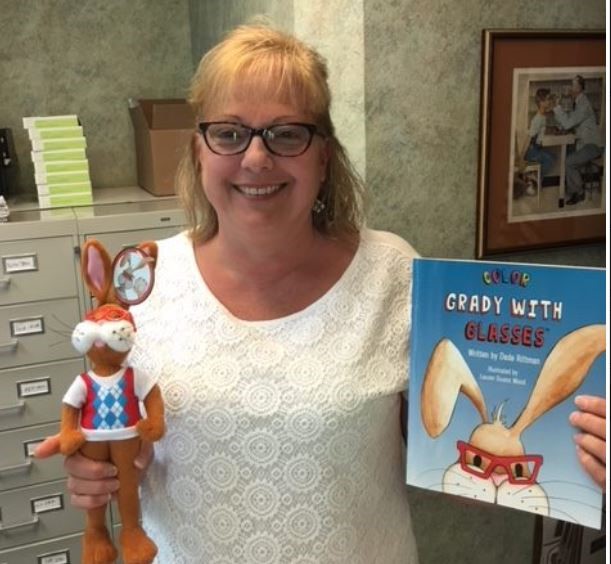
first-pair-of-glassesGrady Gets Glasses, a new program offered by Bissell Eye Care provides a book written by a retired school teacher and local author, Dede Rittman, to young children who receive their first pair of glasses. It talks about the importance of being able to see better and how glasses will help.

For parents of young children, learning your child needs glasses may be a bit overwhelming at first, but you’ll be amazed at the difference in their ability to see clearly and function better. All of the doctors at Bissell Eye Care have young children, so we are accustomed to working with kids of all ages. You may recall a while back, Dr. Long shared her own story about her son’s vision deficit.

Here are some things to consider when choosing your child’s frames. There are more and more options for glasses for young kids, but keep in mind you need to find frames that fit small faces. Different brands offer warranties, for both the frames and the lenses, so be sure to ask. There are three criteria when shopping for frames… FIT, FUNCTION, and FASHION in that order.

Fit is crucial. Glasses need to fit your child today and not size up for future growth. Glasses that fit well stay put, encouraging your child to look through the appropriate part of the lens. They are more comfortable, which encourages compliance, and honestly, they look more attractive. In small children, bigger is definitely not better when it comes to frames. Bigger frames mean bigger lenses that can cause the frames to slide down their nose. Frames that fit well don’t move even while laying down or rough play.

Function. Frame types vary, but the three basic types are wire, flexible, and plastic. The fit is a huge factor in function because glasses that fit well function well. Age and activity of the child go hand in hand when choosing a frame. If you have an infant or an active toddler that needs glasses, you will likely want something flexible and as close to indestructible as you can get, like Miraflex. An older child active in sports may also need a second pair of glasses that are sports goggles. A child who requires an exact bifocal line may do much better wearing a wire frame with nose pads because it gives you the best adjustability.

Fashion is the last on to consider. Glasses that fit and function well for your child are the most important thing, but they will still look adorable in properly fit glasses. Having concerns about your child’s appearance is expected. Be sure not to get caught up in the fashion of the frames if it is to the detriment of fit and function.

With school shopping just around the corner, make sure an eye checkup is on your TO DO list before school starts. Call our offices at 724-443-6767 or 724-226-0444 to schedule your appointment.

About the author: John D. Bissell, owner of Bissell Eye Care and Tri-State Low Vision Services, offers comprehensive eye examinations for the entire family, ocular disease detection and treatment, eye glasses, sun glasses, active wear, contact lenses, and low vision examinations for those with significant vision loss. He has undergone specialized training for treatment of low vision by the International Academy of Low Vision Specialists utilizing customized telescopic eyeglasses, prisms and telescopic implants for patients who qualify. The practice accepts most types of vision and health insurance plans.

EYE STRAIN AND TECHNOLOGY

Has the extreme cold of the winter kept you and your kids indoors more than usual? If so, you have probably realized that they are spending more time on their smart phones, iPad, computers, or on their gaming systems, keeping themselves occupied while trying to combat cabin fever.

New studies show that this increased of use of technology could be causing eye strain for your kids. This eye strain can cause your children to experience things such as headaches or blurry vision.

If your children are like many, they use their iPad on long car trips, a smartboard at school, and seemed to have grown an appendage out of their hand that looks an awful lot like an iPhone. This is just everyday life for them. But as parents, we need to limit their time on the screens.

Some of the symptoms to watch out for in your kids that point to eye strain are:

  • Blurry vision
  • Double vision
  • Headaches
  • Dry, sore eyes

It is important to teach your children how to take a break from technology. Here are a few ways to help ease eye strain.

  • Make time for other activities. Exercise is obviously one of the best activities for your children to do; however, simply spending time away from the screen is important, whether it’s going for a walk or cleaning their room. Board games for some family time are a great alternative.
  • Proper distance. Your child should not be right up against the screen. If you find they are constantly sitting close to the TV or have their phone/iPad in their face it might be an indicator that they are having trouble seeing.
  • Blink often. When children, even teens, stare at a screen for long periods of time they have a tendency to blink less often. This can cause the eyes to dry out and may cause discomfort and pain. Be sure to remind them that even when they are intently focused on the screen that it is important to blink.
  • Look away. A good rule of thumb is the 20-20-20 rule…for every 20 min of use you should be looking away from the screen for at least 20 seconds and focus on an object that is 20 feet away. This gives your eyes a chance for a break so that they are able to focus better.

As with anything else, the key to vision health is moderation. While playing on the iPad will not immediately hurt your child’s vision or cause discomfort, prolonged over usage will lead to eye discomfort and may lead to eye difficulties.

About the author: John D. Bissell, owner of Bissell Eye Care and Tri-State Low Vision Services, offers comprehensive eye examinations for the entire family, ocular disease detection and treatment, eye glasses, sun glasses, active wear, contact lenses, and low vision examinations for those with significant vision loss. He has undergone specialized training for treatment of low vision by the International Academy of Low Vision Specialists utilizing customized telescopic eyeglasses, prisms and telescopic implants for patients who qualify. The practice accepts most types of vision and health insurance plans.

ARE YOU READY FOR SCHOOL?

Back to school concept with school items and elements. vector banner design

As the first day of school rapidly approaches it is time for the annual back to school shopping for clothes, backpacks, pencils, pens and book covers. This is also a great time to schedule your kids’ annual eye exams. Did you know until the end of September 2017 we have a back to school sale – buy one pair and get a second pair 50% off? This sale isn’t limited just to your kids.

August is children’s eye health and safety month. As a good rule of thumb you should have your children’s eyes examined by an eye care professional during their well visits starting around the age of three, and also before the start of each school year. If your children struggle to see, it may inhibit their ability to learn as they head back to school this year.

Your children’s eye doctor can help to ensure that they are seeing clearly. These exams look into the back of the eye for overall eye health, but are also able to detect things such as:

  • Ptosis (drooping of the eyelid)
  • Color deficiency (color blindness)
  • Amblyopia (lazy eye)
  • Strabismus (cross eyes)

Early detection of vision problems can make a big difference when it comes to your child’s ability to learn. If they suffer to see, they will more than likely suffer to learn as many people learn by sight.

Keeping your children’s eyes safe is another part of maintaining healthy vision. Did you know that eye injuries are the leading cause of vision loss in children? There are a few basic rules that you should follow to help ensure that your child is not one of the 42,000 sports related eye injuries that occur each year.

  • All children should wear protective eye gear while participating in sports or physical activities.
  • Be sure to purchase age appropriate toys and avoid those toys which have sharp or pointy edges.

Give your kids the best chance of success this year by scheduling a comprehensive eye exam. Make sure that your children are able to see clearly. Protecting their ability to see will help them to have the best chance of success as they head back to school this year!

About the author: John D. Bissell, owner of Bissell Eye Care and Tri-State Low Vision Services, offers comprehensive eye examinations for the entire family, ocular disease detection and treatment, eye glasses, sun glasses, active wear, contact lenses, and low vision examinations for those with significant vision loss. He has undergone specialized training for treatment of low vision by the International Academy of Low Vision Specialists utilizing customized telescopic eyeglasses, prisms and telescopic implants for patients who qualify. The practice accepts most types of vision and health insurance plans.

EYE EXAMS FOR KIDS

Attentive boy is looking in special apparatus, checking his sight. Portrait

As parents, it is easy to know when your child is sick or needs to be taken to the doctor. It is often more difficult for your child to know and tell you when they aren’t seeing as clearly as they should be. This is especially true with infants and toddlers.

Unlike adults that have had regular exams, children who have never had an exam do not have a baseline to measure their vision from. The world is new and exciting to them and they may not notice that what they are seeing is not as clear as they should be. As a parent, you can help to ensure they are experiencing life to its fullest by scheduling routine eye exams.

According to the American Optometric Association, infants should have their first eye exam at 6 months of age. Children should then receive their next eye exam at the age of 3 and then again at age 5-6, before they enter kindergarten.

As your children age, it is recommended that they receive a comprehensive eye exam every two years if no vision correction is required and every year if vision correction is required. While pre-schools and elementary schools do provide free eye screenings, they are not nearly as involved as a screening by your optometrist.

School exams check the basics, using the Seeing Eye Chart but do not look into the eye to see if there are any other issues that need to be corrected before permanent damage occurs. Often these screenings are inaccurate and can miss important eye issues because they are always not done by eye doctors but by school nurses or medical assistants not trained to pick up advanced eye issues. Reading a chart or looking into a machine is not a proper assessment of the visual function of the eye. An eye doctor can see if a nonverbal or young child needs glasses by dilating them and using a special scope that shines light into their eyes to read their glasses prescription.

As children grow they use their vision to develop skills such as:

  • Eye teaming (binocularity) skills.
  • Focusing skills.
  • Peripheral awareness.
  • Eye movement skills.
  • Eye/hand coordination.

It is important to give your child the proper start as you get ready to send them on their first day of school. If they have trouble seeing they will struggle to learn. At a young age we learn from what we see, from how we see other people interact and what the teacher writes on the board. If your child does not have the ability to see clearly, they are already starting out a few steps behind.

As parents, we would do anything to be able to help our children to be the best they can be. Vision is often one area where children may not know that something isn’t right. If they have poor vision they most times won’t feel pain or discomfort, they will simply just struggle to see in clarity. For this reason, they may not tell you that they are having trouble as blurry vision may have become “normal” to them.

As you complete your back to school to do list, be sure to schedule your child’s eye exam.

About the author: John D. Bissell, owner of Bissell Eye Care and Tri-State Low Vision Services, offers comprehensive eye examinations for the entire family, ocular disease detection and treatment, eye glasses, sun glasses, active wear, contact lenses, and low vision examinations for those with significant vision loss. He has undergone specialized training for treatment of low vision by the International Academy of Low Vision Specialists utilizing customized telescopic eyeglasses, prisms and telescopic implants for patients who qualify. The practice accepts most types of vision and health insurance plans.